Five examiners · Real voices · Your actual thesis

Your defense should not be the first time someone questions you on your own work.

Upload your dissertation, thesis or project. Our AI examiners read it, then question you out loud until the answer holds. Nothing your real examiners ask will feel new.

A new account opens with 20 credits: about 4 minutes with the real panel, on your own thesis, and no card.Undergraduate projects to PhD theses, in any discipline.

Full DefenseExample sessionIn session19:05
Grounded inMethods
Dr. RodriguezMethods & Limitations

Examiner speaking

Ground examined

LiteratureTheoryMethodsFindingsContributionLimitationsOwnership
FORMAL WARNINGS0 of 3 · the panel may suspend the examination

Issues the panel is tracking

HeldA single case carrying the whole argument
OpenHow contradictions were coded
OpenOrigin of “implementation distance”
An example, sped up. Voices are off on this page.

Watch an examiner press past a plausible answer

Recorded live in a Full Defense. The methodology examiner asks how the candidate reconciles documents that contradict their interviews, hears a reasonable answer, and asks how that difference was actually coded.

Full Defense · methodology · recorded 11 September 2026Recorded

A real examination by the real panel. The candidate is a stand-in, not a student, so the session could be recorded. Captions available.

Any hour, any day You answer out loud Undergraduate to PhD

From dissertation to a defense you have already rehearsed

1Upload your work
Add your dissertation and, if you have them, your slides. The examiners read both before the first question.
2Answer out loud
Questions come from your own chapters, and each one names the ground it stands on. A vague answer gets asked again.
3See where it was thin
After every answer you see what held, what did not, and what the examiner did with it: pressed further, moved on, taken up by a colleague. At the end, which parts of your thesis were never reached.

Start with one examiner. Build up to the panel.

Two rooms, and most students use both. One examiner to practise in weekly, and a full panel for the fortnight before.

Recommended start

Practice Defense

One examiner who has read your work, and will not let a vague answer stand.

  • ·Standard, Rigorous, Brutal
  • ·Out loud, or typed if you would rather
  • ·Included from the Student plan up.
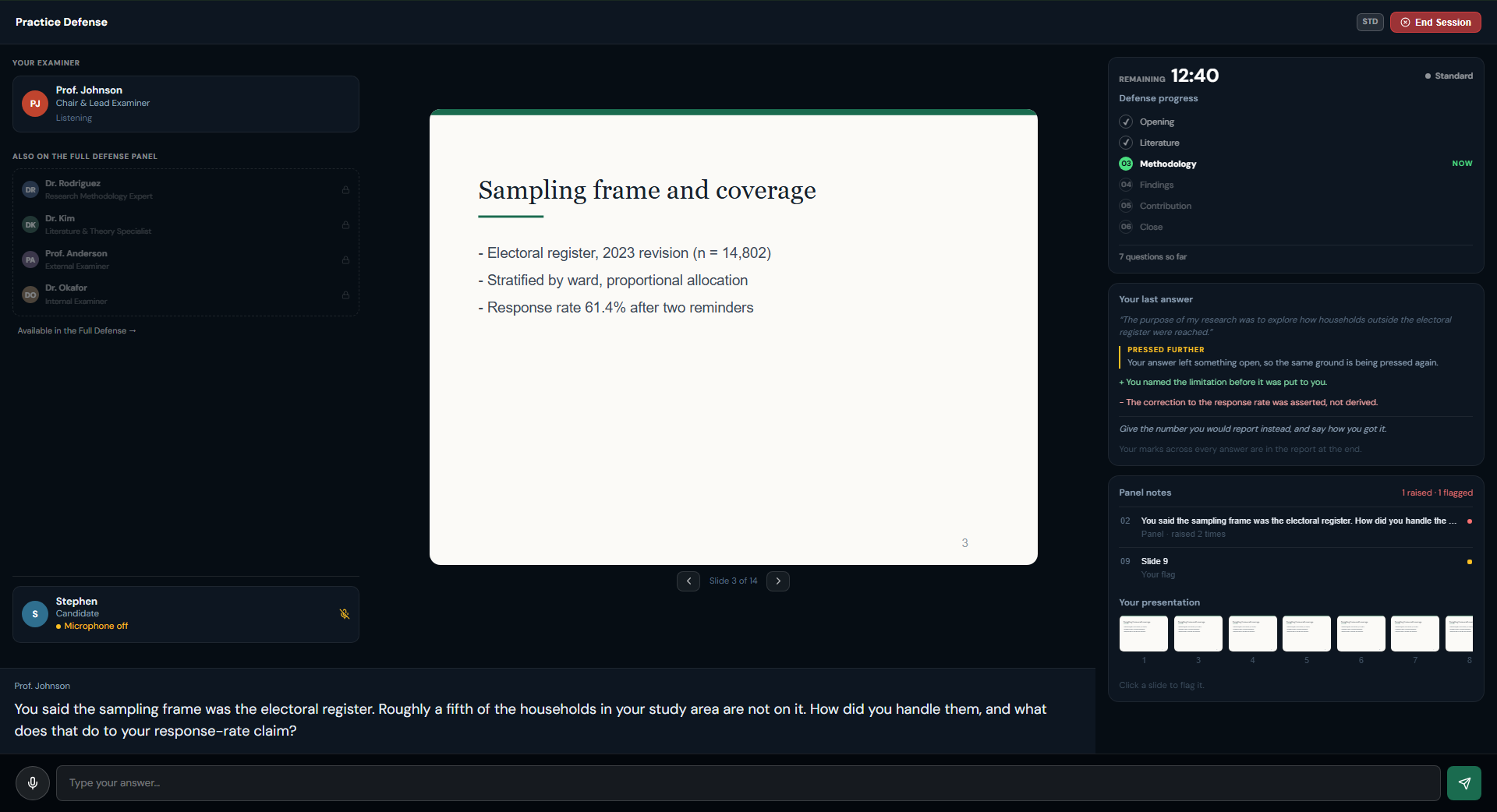
VivaVoca Practice Defense: one examiner who has read your dissertation questions you aloud, with feedback on your last answer beside the slides
One examiner, spoken, with feedback after every answer
How the Practice Defense works
Premium

Full Defense

The whole examination, from your first slide to the panel’s decision.

  • ·Your presentation, then the questions
  • ·The panel withdraws, deliberates, and returns a decision
  • ·An examiner report, and a Certificate of Defense Readiness
Who is in the roomall five, out loud
PBChairs the panel
DRMethods & Limitations
DCLiterature & Theory
PHContribution & Ownership
DOFindings

Four specialists, each answerable for a different part of your thesis, and a Chair who only exists once there is a panel to run. Every question is spoken, and they hand the floor to each other.

Meet the panel
After every answer

Know where each answer was thin

Each answer gets the judgement an examiner would make, and the reason for it.

This is the Practice Defense, between questions. The Full Defense does not interrupt itself to tell you — no real panel does — so it comes afterwards, in the examiner report.

Tied to the ground it stands on
Every question names what it is examining: your research design and methods, the limits of what your work can show, and five more.
What held, and what was missing
What stood up in your answer, what did not, and what the examiner did next: pressed the same ground again, moved on, or handed it to a colleague.
How you sounded
Words a minute, Filler words, Softened claims, How much you read aloud. Measured, not guessed at.
The next session opens there
Anything left open is carried forward, and your next defense opens on it rather than starting again from the beginning.
ExaminerExample

Your documents and your interviews disagree about the same policy. How do you reconcile them?

You

“I resolve it by treating documents and interviews as different dimensions of the same condition.”

Pressed furtherYour answer left something open, so the same ground is being pressed again.
+ You named both sources and said how they relate.
- You did not say what you concluded where they disagree.
Up to 5
Specialist examiners
One panel. Each examines a different part of your work, and they hand the floor to each other.
7
Parts of your thesis
From the literature to whether the work is yours: every part has an examiner who answers for it.
4
Delivery measures
Words a minute, filler words, softened claims, and how much of each slide you read out. Slide by slide.
24/7
Always open
No appointment to book. Practise the night before, as many times as your credits allow.

What you are left holding

A rehearsal you cannot show anyone is worth less than one you can. These are the documents a Full Defense ends with.

DECISION
A decision, not a score
Pass, pass with minor corrections, major corrections, re-examination, or fail: the five a real panel can reach. Settled by rules the panel is held to, never by how the examiners happened to feel. No session ends with "you scored 78%".
EXAMINER REPORT
Where each answer was thin
What they asked, what each answer was worth, and, the part nobody else tells you, which parts of your thesis they never got to: so you know what is still untested.
PRACTICE RECORD
A certificate that can be checked
A Certificate of Defense Readiness with an ID that resolves to a public page. Your supervisor can open it and see the room, your level and how many questions you answered. It publishes no score, because a score is not a thing to certify. It records practice. It is not an academic result.
CORRECTIONS ROOM
And a room for after the real one
When your real examiners hand you a list and a deadline, the Corrections Room works through it with you. It never marks a correction accepted; only your examiners can do that. It tracks what you have done, under their words, not over them.

Six things, and when to use each

Two of them examine you. One presents for you. Three help you get the document right first.

Defend

Practice DefenseStudent
One examiner who has read your work, and will not let a vague answer stand.
Weekly practice. The room to live in for the month before.
Full DefensePremium
The whole examination, from your first slide to the panel’s decision.
The fortnight before. The closest thing to the real room.
AI PresenterPremium
Hear your defense delivered before you have to deliver it.
Rehearsing the opening. Hearing your own argument from outside it.

Prepare

Dissertation GraderAll plans
Your whole document read section by section, then graded as one piece of work.
Before you submit. And again after you have acted on it.
Supervision MeetingPremium
Chapter-by-chapter help from something that has read the whole thing.
The long middle of writing, when a supervisor is a fortnight away.
Content LibraryStudent
What a viva in your discipline actually asks.
Early, while you still have time to change something.

Meet the panel

A Chair and four specialists, each answerable for a different part of your thesis, and each telling you which part before the first question is asked.

Full Defense · the panel takes its seatsRecorded

A real examination by the real panel. The candidate is a stand-in, not a student, so the session could be recorded.

PB
Prof. Bennett
Chairs the panel
Answers for the examination itself: keeps the order, the clock, and makes sure every ground is covered.
DR
Dr. Rodriguez
Methods & Limitations
Here to examine your research design and methods, and the limits of what your work can show.
DC
Dr. Chen
Literature & Theory
Here to examine the literature and where your work sits within it, and your theoretical framework.
PH
Prof. Haddad
Contribution & Ownership
Here to examine what your work contributes, and how the work came to be your own.
DO
Dr. Okafor
Findings
Here to examine your findings and how you analysed them.

For the defense you will actually sit

Undergraduate project, Master’s dissertation or PhD thesis, in any discipline: set your format and level, and the panel examines to that bar.

13 examination formats and 10 levels, from an undergraduate project presentation to a doctoral defense, including a proposal defense, a comprehensive exam and an upgrade panel.

UK Viva
  • Private, with no audience
  • An internal and an external examiner
  • Outcome under a corrections framework

Where each one stops

Compared with what students use now

FeatureVivaVoca
Recommended
General AISupervisorsMock with peers
Asks the questions instead of answering them✓~✓✓
Has read your actual dissertation before it asks✓~✓~
Checks your slides against your thesis, and opens on the contradiction✓~~~
Speaks, and makes you answer out loud✓✓✓✓
Refuses a vague answer and asks again✓~✓~
Several examiners who disagree with each other✓~~✓
Measures your delivery: words a minute, fillers, hedging✓✗✗✗
Refuses to score what it never examined✓✗~~
Remembers your last defense and opens on what you failed✓~✓~
The verdict follows rules, not the model's mood✓✗~✗
There at 2am in the week before✓✓✗✗
Knows your field well enough to press you on it~~✓✓

Your supervisor matters more than anything on this table. They are also one person with a queue. VivaVoca is for the hours they cannot give you.

✓ = Full support  ·  ~ = Partial  ·  ✗ = Not available

Unpublished work

What happens to the thesis you upload

You are being asked to upload research nobody has published yet, to a company you met ten minutes ago. Here is exactly what we do with it.

It stays yours

Uploading transfers nothing. The copyright and every other right in your dissertation are yours before you upload it and yours afterwards. We claim no license to publish, reuse or quote it.

It never trains a model

Not ours and not OpenAI’s. Your text is used to produce your own session and nothing else. This is in the privacy policy because it is a commitment, not a preference.

No other student can open it

Your uploads are scoped to your account and the rules that enforce it run on the server, not in the browser. They are tested against the real rules engine before any change to them ships.

Where it goes, and why

One third party ever sees your text, and it never trains a model: OpenAI, which generates the examiners’ questions, the voice and the grading. We name it in the privacy policy rather than writing “our AI providers”, because a supervisor or institution reviewing us needs the name to check it.

Encrypted on the way and at rest

HTTPS in transit, encrypted storage, and server-side access rules. No service can promise that nothing on the internet ever goes wrong, and we do not.

Removed when you ask

Email [email protected] and your account and everything in it is deleted. It is a request rather than a button today; we would rather say that than imply a switch that does not exist.

Read the privacy policy

Simple, Honest Pricing

Pay once. Your plan runs 30 days; your credits never expire.

First 4 minutes free
Every new account
4 minutes
with the panel, before you choose any plan
20 credits on the account the moment you create it. No card.
The real panel and your own thesis, not a recording
When it ends the panel waits, and nothing is lost
Student
$00 one-off
120 credits
$0.14 per credit · credits never expire
120 credits buys
Practice Defense · standard120 min
Practice Defense · live24 min
One pool of credits; these are alternatives, not additions.
  • Practice Defense: one examiner questions you on your slides and dissertation
  • Answer aloud, or in writing
  • Every difficulty: Standard, Rigorous and Brutal
  • Dissertation Grader
  • Content Library
  • Certificate of Defense Readiness
  • The panel, its deliberation and its verdict are the Full Defense, on Premium
MOST POPULAR
Premium
$00 one-off
350 credits
$0.08 per credit · credits never expire
350 credits buys
Practice Defense · standard350 min
Practice Defense · live70 min
Full Defense · standard175 min
Full Defense · live70 min
One pool of credits; these are alternatives, not additions.
  • Everything in Student Plan
  • Full Defense (viva voce): present your work to a panel, defend it under their questioning, then their deliberation, verdict and report
  • Your presentation time is never charged
  • Supervision Meeting
  • Panel of up to 5 examiners
  • AI Presenter
  • AI defends your work in your place, before a panel
Pay by card · secure checkout · one payment, nothing recurring
Prices in USD. Sales tax or VAT is applied at checkout according to your country.
For institutions

For supervisors and graduate schools

Give every candidate a rehearsal before the room, without adding hours to your supervisors’ week. Supervisor accounts cost nothing.

How a department pilot works
Credits for a cohort
Buy for a department on one invoice and put the credits straight onto your students’ accounts as their dates are set.
Your format, and your bar
Set the examination format from 13 and the level from 10, and the panel examines to that bar. An MPhil is never asked for an original contribution to knowledge.
What you see, and what you do not
Give a student your examiner code and every defense they finish reaches you automatically, the Practice Defense and the Full Defense alike: the score, and a transcript of the questions and their answers. Without a code, nothing reaches you unless the student sends you a link. We never store audio of a session; what is kept is text.

Frequently Asked Questions

Everything you need to know before you start

No, and it is worth being direct about it. Nothing here writes your thesis, drafts your answers or produces text for you to submit. It asks you questions about work you have already written, and tells you how you answered them. It is rehearsal, in the same way a mock viva with a colleague is rehearsal.
Yes. Your dissertation is used within your session and is never used to train any AI model. All data is encrypted at rest and in transit. Your own browser keeps a copy so you do not have to upload the same thesis twice: it is tied to your account, nobody else signing in on that computer can open it, and signing out removes it.
No, and it is built to make that hard. It refuses to score a competency it never actually examined, so a short session returns fewer marks rather than invented ones. The outcome is decided by rules in code rather than by the model's judgement on the day, and it will return Major Corrections or a Fail where the answers earn them. Grade the same chapter twice and you get the same mark.
A general chatbot can be told to quiz you, and it will, for a while. The differences are structural rather than a matter of prompting: it cannot measure how fast you spoke or how often you hedged, it will fill in a score for competencies it never tested, it gives the same chapter a different mark each time, and it has no rules layer under its verdict. And it does not open your second defense on the thing you failed in your first.
Yes, and this is the part institutions actually use. An examiner or supervisor creates a profile and generates a code, something like VV-MWA-X8K2. Inside it they set the issues they want pressed, their own questions, and the focus areas that matter for that student's work. The student enters that code on either the Practice Defense or the Full Defense, and the panel examines them on the viva questions their examiner set. The examiner's questions and rubric are never sent to the student's browser, so the code cannot be used to read the examination in advance. The examiner then sees each student's readiness and can compare across the group, and a department can add a whole cohort at once from a CSV and export progress for the year. The Examiner Portal is free.
The session pauses. It does not end. You top up where you are standing, and the examination carries on from the question you were on, with the clock pushed forward by the time you spent away. You never lose an uploaded dissertation, and you are never sent to another page to pay.
You can resume. The panel picks up the question it had already asked rather than starting over, and it welcomes you back rather than introducing itself again. If there were under two minutes left, the defense is treated as finished.
No. Without them you go straight to the questions and are examined on your thesis alone. With them, the panel reads both and opens on anything the two disagree about, and can ask you to turn to a particular slide.
Undergraduate to doctorate, and the standard genuinely changes with the level. An MPhil is never asked for an original contribution to knowledge, because that is the line separating it from a PhD. The panel is told which bar it is examining against.
It depends on whether you used their code. If you entered an examiner or supervisor code, every Practice Defense you finish is sent to them the moment it ends: your score, and a transcript of the questions and what you said, including how fast you spoke and how often you hesitated. That is what the code is for, and it now covers the Full Defense as well as the Practice Defense. If you did not enter a code, nothing reaches anyone unless you send it yourself: a share link or a verification record, and the record quotes your answers word for word. We never store audio of any session.
Card payments are accepted worldwide: Visa, Mastercard and PayPal, through Paddle, our payment processor. Students in Zambia can also pay by mobile money.
No. Your supervisor knows your field, your institution and the regulations you will be examined under, and none of that is replaceable. They are also one person with a queue. This is for the hours between their meetings: the practice they do not have time to sit through with you.
It is the panel’s judgement on that one session, reached by rules in code rather than by how the examiners felt on the day. It is practice feedback and not an academic result, it does not predict your real outcome, and no university has made it. The same answers would reach the same decision; your real examiners may reasonably reach a different one.
Credits are spent by the minute while an examiner is questioning you, so a short focused session costs little. Live voice costs more per minute than standard, because it costs us more. Your own presentation time in a Full Defense is not charged at all, and the panel’s deliberation is charged once, flat, rather than by how long they take. Credits never expire.
A recent version of Chrome, Edge or Safari, a microphone and somewhere quiet. Headphones help: without them the examiners’ voices come out of your speakers and back into your microphone, and the room can mistake them for you. You can also answer by typing instead, in the Practice Defense and in a standard-mode Full Defense.

Walk into your defense having already answered the hard questions.

Answer out loud, find out where each answer was thin, and do it again before it counts.